
This post may contain affiliate links. Please see our disclosure policy.
Learn how many ounces are in a pint with this comprehensive guide! We’ll show you how to measure liquid and dry ingredients interchangeably so you can measure and convert with ease
Have you ever found yourself making a recipe and suddenly unsure about the ounces in a pint? While online calculators are an option, they’re not always reliable or user-friendly. We’re here to simplify the conversion process for you, ensuring success with all your recipes.
Our guide covers everything you need to know about converting ounces to pints accurately. We even include tips for measuring both dry and wet ingredients. Before you know it, you’ll be effortlessly converting and measuring with ease!
Table of Contents
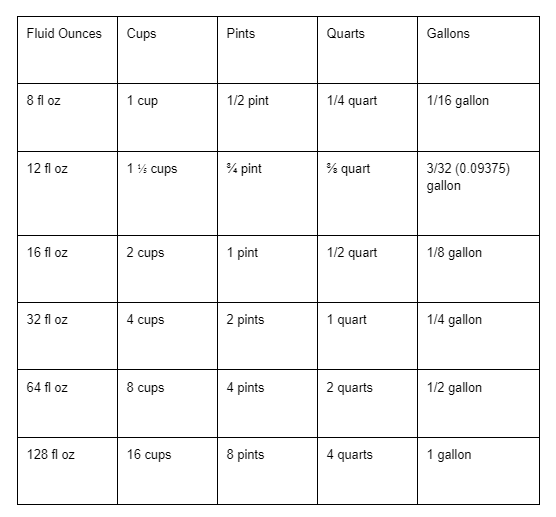
How Many Ounces in a Pint?
Below is a chart for quick conversions:
What is an Ounce?
An ounce is a unit of measurement used to weigh out volume, weight, and mass. The United States, and a couple of other countries, use this unit of measurement to weigh small amounts of ingredients. The rest of the world typically measures smaller amounts in grams.
What is a Pint?
The term pint serves as a unit of volume measurement utilized in both the imperial and U.S. customary systems. In the imperial system, a pint equates to 20 fluid ounces. Meanwhile, in the U.S. customary system, it equals 16 fluid ounces.
Pints (pt) typically measure liquids like milk, water, beer, and other beverages. Although less common, they can also measure certain dry ingredients in cooking and baking.
Dry vs Liquid Measurements
Let’s delve into liquid measurements first. In the U.S. measurement system, a liquid pint comprises 16 fluid ounces. However, an Imperial pint contains 20 fluid ounces. This discrepancy comes from the slight variation in measurement standards between these two systems.
In the U.S. customary system, a dry pint typically equals about 18.618 fluid ounces. Meanwhile, in the Imperial system, a dry pint equals about 20 fluid ounces.
However, when converting dry ingredients, such as flour or sugar, to ounces, it’s important to note that the weight can vary. Factors such as density and moisture are the most common causes of weight discrepancies. As a general rule of thumb, a dry pint of most commonly used dry ingredients, like flour or sugar, weighs approximately 16 ounces or one pound.
How to Measure an Ounce and Pint Internationally (Imperial vs. Metric Systems)
Now that you’re familiar with how many ounces are in ounces in a pint, let’s explore the various ways a pint is measured across the globe!
In U.S. measurements, a pint equals 473 milliliters.
In Australia, Canada, and New Zealand, a pint is defined as 20 imperial ounces. This is equivalent to 18.432 U.S. fluid ounces, making it slightly different from the U.S. pint.
In Austria, Denmark, Germany, and Sweden, a pint measures as 500 milliliters. This is approximately equal to 16.91 U.S. fluid ounces, making it quite close to the U.S. measurement.
Wet vs. Dry Pint
Navigating wet versus dry measurements can be a bit tricky. This is largely because we introduce a whole different unit of measurement – volume.
A dry pint equals 16 ounces, while a liquid pint equals 20 ounces. The distinction between these two lies in the density of the fluid. Liquids tend to be less dense than solids, meaning they occupy more space.
This explains why a liquid pint contains 20 ounces, whereas a dry pint only holds 16. It might be helpful to remember that regardless of whether you’re using wet or dry ingredients, two cups make a pint, and two pints make a quart.
Fluid Ounces vs. Dry Ounces
It’s crucial to understand that wet and dry ingredients have distinct densities. For instance, solids are denser than liquids, requiring different measurement approaches. When cooking, keep in mind that there are two types of ounces: fluid ounces (fl oz) and dry ounces (oz).
If your recipe specifies measurements in ounces or pounds for ingredients like flour or sugar you’ll need to use a kitchen scale to measure the precise weight. For liquid ingredients, use a liquid measuring cup for accurate measurement. Here is a breakdown of the differences between fluid ounces and dry ounces.
Fluid Ounces:
- Definition: Fluid ounces (fl oz) measure volume, specifically the volume of liquid.
- Usage: They are commonly used in recipes to measure liquid ingredients such as water, milk, oil, or juice.
- Representation: Fluid ounces are often denoted by “fl oz” or simply “oz” with a fluid measuring cup symbol.
- Conversion: 1 fluid ounce is equal to approximately 29.57 milliliters in the metric system.
- Examples: A cup of water typically equals 8 fluid ounces, while a standard soda can contains 12 fluid ounces.
Dry Ounces:
- Definition: Dry ounces measure weight, specifically the weight of dry ingredients such as flour, sugar, or grains.
- Usage: They commonly measure dry ingredients for baking and cooking.
- Representation: Dry ounces are often denoted by “oz” without any additional symbols.
- Conversion: 1 dry ounce is equal to approximately 28.35 grams in the metric system.
- Examples: A standard cup of all-purpose flour typically weighs around 4.25 dry ounces. Meanwhile, a cup of granulated sugar weighs approximately 7 dry ounces.
In summary, fluid ounces measure volume and are used for liquids. However, dry ounces measure weight and are used for dry ingredients. Understanding the distinction between these two units is essential for accurate measurement in cooking and baking.
Frequently Asked Questions
In the United States customary system, a pint consists of 16 fluid ounces. Conversely, in the Imperial system, as utilized in countries like the United Kingdom, a pint contains 20 fluid ounces. It’s important to note the difference depending on which system of measurement you are using.
In the context of fluid ounces to pints, there are 0.0625 pints in one fluid ounce.


A pint is 1/2 of a quart, which contains 32 fluid ounces, so a pint equals 16 fluid ounces, not 20.
There is a paragraph in the post which explains:
“The term pint serves as a unit of volume measurement utilized in both the imperial and U.S. customary systems. In the imperial system, a pint equates to 20 fluid ounces. Meanwhile, in the U.S. customary system, it equals 16 fluid ounces.”
Hope that helps!