
This post may contain affiliate links. Please see our disclosure policy.
One of the world’s most famous cheeses, Camembert is a creamy and delicious cheese, perfect on its own or baked into dishes. In this post, you’ll discover its history, how to choose a wheel, how to store it, and how to bake it.

Table of Contents
What Is Camembert?
Camembert is a soft-ripened cow’s milk cheese originating in Normandy, France, first made in 1791 by Marie Harel. A true Camembert de Normandie is protected under PDO/AOC laws and made with raw milk, though most commercial versions today use pasteurised milk.
It features a white rind created by Penicillium camemberti, and a creamy interior. As it ages, the interior becomes buttery, runny, with a strong flavour.
Camembert vs. Brie
Camembert is often compared to Brie, but differs in ripeness, size, and flavour profile. With slightly lower fat content and a stronger taste, it has stronger umami notes. Its soft rind makes it ideal for melting or serving at room temperature as part of entertaining.
Can Camembert be made anywhere in the world?
Yes, Camembert cheese can be made globally, but only Camembert de Normandie (made in Normandy, France, using traditional methods) has protected designation of origin (PDO) status. This means that while many countries produce similar cheeses, only those made under strict guidelines in this region can legally carry the official name. Outside France, most Camembert-style cheeses are pasteurised and labelled simply as “Camembert”.
Buying, Storing & Serving Camembert
Choosing the Best Wheel
Camembert usually comes in small wheels, and you can easily buy a whole wheel in supermarkets.
Look for an AOC or PDO label if you are looking for authenticity. PDO means Protected Designation of Origin, so it means that a product’s features are linked to a specific area in the world and traditional production methods.
If you can choose the wheel unwrapped at a cheesemonger’s, you want the rind to be white, and the cheese should give slightly when pressed.
How to Store Camembert
Wrap it in wax or baking paper, not plastic, and keep it in the fridge. Take it out 30 minutes before serving – this softens it to the right texture and also intensifies the flavour.
Serving Ideas
- On a charcuterie & cheese board with crusty bread, fig jam, walnuts, cornichons or apple slices.
- Wrapped in puff pastry to make Camembert en Croute.
- In little pumpkin pastries full of cranberries and camembert.
- Nestled into a ham and cheese croissant bake.
- Melted into a tomato & onion galette (swap the goat’s cheese for camembert).
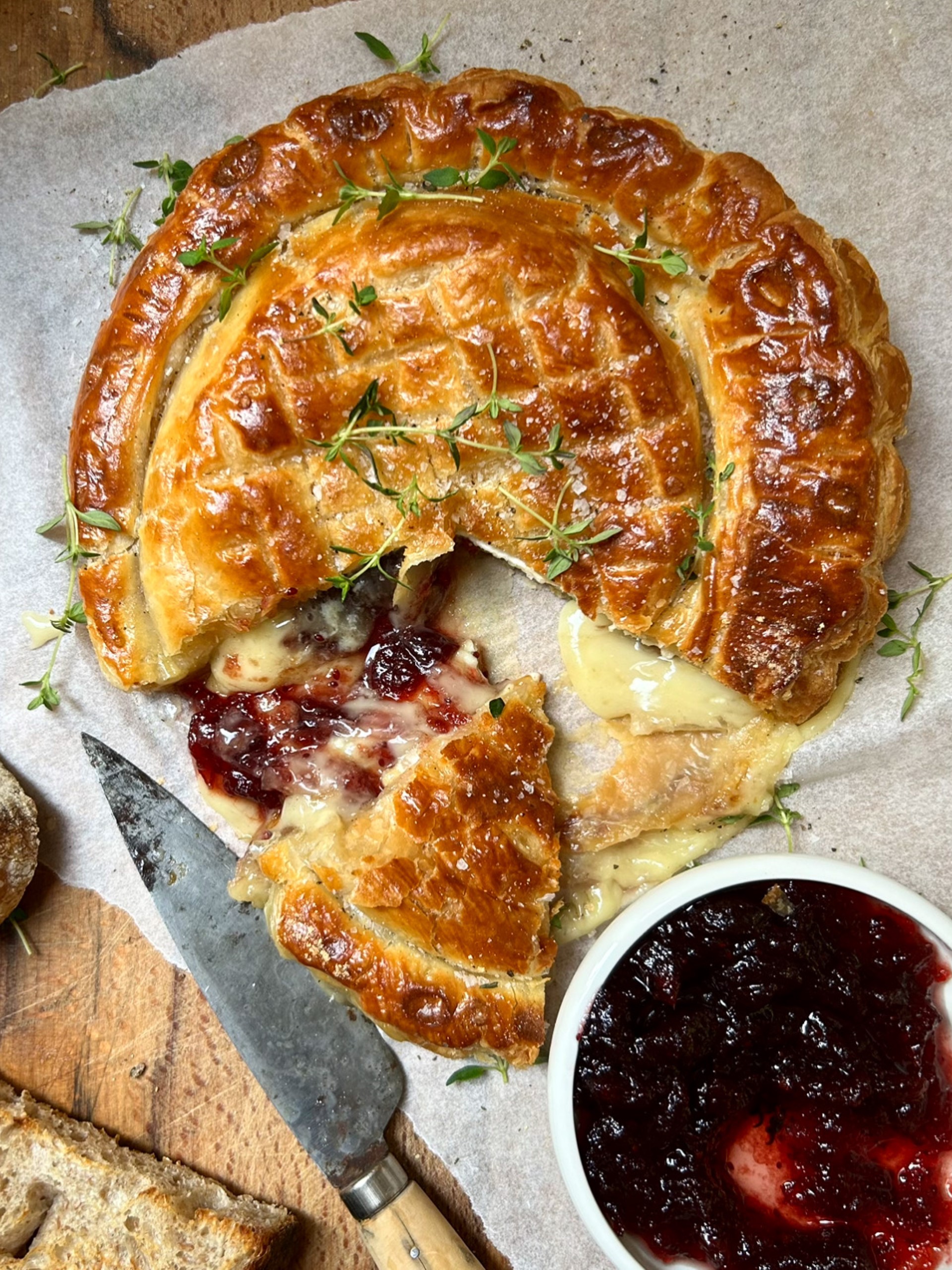
How to bake camembert
Ingredients:
- 1 whole Camembert (250g), ideally in a wooden box
- 1-2 sprigs of fresh herbs (rosemary, thyme, oregano work well)
- 1-2 tbsp olive oil
- Black pepper
- Optional extras: thinly sliced garlic, sun-dried tomatoes, honey, toasted nuts, or jam.
Step 1: Prep the Cheese
Preheat your oven to 190°C (375°F).
Take the Camembert out of any plastic or paper wrapping but leave it in its wooden box (if the box is oven-safe). If not, pop the cheese into a snug-fitting ovenproof dish.
Step 2: Add Flavour
Use a sharp knife to score a circle in the top rind of the cheese, leaving a small border. Gently peel this top layer off to reveal the soft cheese underneath. Tuck in your fresh herbs and any extras like garlic or sun-dried tomatoes into the top of the cheese.
Step 3: Drizzle & Bake
Drizzle with olive oil and a little cracked black pepper.
Place the cheese (still in the box or dish) onto a baking tray and bake for 15-20 minutes, or until the centre is gooey and molten.
Step 4: Finish & Serve
Optional but delicious: drizzle with honey, sprinkle with toasted nuts, or add a spoonful of fruit preserve for a sweet-savoury twist.
Serve immediately with crusty bread, crackers, or fresh apple or pear slices.
Tips for the Best Baked Camembert
- Bring to Room Temp First: Let the cheese sit out for 30 minutes before baking, it helps it melt evenly.
- Check the Box: Not all wooden Camembert boxes are oven-safe. If in doubt, wrap the base in foil or use a baking dish.
- Customise Your Toppings: Try a handful of walnuts, dried cranberries, or a sprinkle of chilli flakes for something different.

Frequently Asked Questions
Camembert is smaller, firmer, often stronger in flavour and lower in fat than Brie; it also uses unique mould cultures for its distinctive texture
Score the top rind and stud with garlic or drizzle with honey. Wrap loosely in foil with herbs, and bake at 180 °C for about 15-20 min until oozy.
I wouldn’t freeze camembert as I find the texture is changed. Store in paper in a cool fridge and enjoy at room temperature.
Camembert is made from cow’s milk, traditionally unpasteurised, and undergoes a soft-ripening process.
– The milk is curdled using rennet, then the curds are moulded into small round forms and drained.
– After salting, the cheese is inoculated with Penicillium camemberti, a white mould that creates the soft, edible rind.
– The cheeses are aged for at least 21 days, during which the interior softens and develops its signature creamy texture and earthy, mushroomy flavour.
Absolutely. The rind on Camembert is edible and safe to eat. In fact, it’s considered an essential part of the flavour experience.


